
Medical treatments for hair loss are primarily designed to preserve existing hair rather than regrow significant amounts of hair that has already been lost. While some patients experience modest thickening of miniaturized hairs, most medications work by slowing the progression of androgenetic alopecia rather than reversing it. In many cases, hair loss continues despite treatment, but at a slower rate than would otherwise occur. For this reason, medical therapy is generally best viewed as a way to preserve existing hair and potentially delay further loss rather than as a cure for baldness.
It is also important to understand that these treatments do not affect all patients equally. Some individuals experience meaningful benefits, while others notice little or no improvement. Similarly, some patients tolerate medications without difficulty, while others experience side effects even at relatively low doses. Genetic factors, age, degree of hair loss, individual medication sensitivity, and many other variables can influence both effectiveness and tolerability. Unfortunately, there is currently no reliable way to predict exactly how any individual patient will respond.
Finasteride is an FDA-approved prescription medication for male pattern hair loss. It works by inhibiting the type II 5-alpha reductase enzyme, which converts testosterone into dihydrotestosterone (DHT). DHT is one of the primary hormones responsible for the gradual miniaturization of genetically susceptible hair follicles.
Finasteride may help slow the progression of male pattern hair loss and preserve existing hair. Some patients also experience improvement in the appearance of miniaturized hairs. However, finasteride is generally more effective at preserving existing hair than regrowing hair that has already been lost. Because transplanted hair is generally resistant to DHT while native hair remains susceptible, finasteride is often used before or after hair transplantation to help maintain surrounding native hair. However, results are gradual, often subtle, and the medication does not recreate a youthful hairline or restore large areas of baldness.
Possible Side Effects:
Although side effects are uncommon, patients should discuss the risks and benefits with their physician before beginning treatment.
Understanding DHT:
Finasteride lowers DHT levels but does not eliminate testosterone. Interestingly, there is a rare genetic condition in which some individuals are born with little or no functional type II 5-alpha reductase enzyme. As a result, they naturally produce significantly lower levels of DHT throughout life.
Observations from these individuals have helped researchers better understand the role of DHT and contributed to the development of medications such as finasteride. These individuals are generally healthy, although they may exhibit differences in sexual development and secondary sexual characteristics. While this does not mean finasteride is free of side effects, it does provide evidence that reduced DHT levels can often be tolerated without major health consequences in many individuals.
For some patients who experience side effects with oral finasteride, topical finasteride may be considered. Because it is applied directly to the scalp, it may result in less systemic exposure than oral treatment, although absorption into the bloodstream can still occur.
Although topical finasteride may be a reasonable option for selected patients who experience side effects with oral treatment, oral finasteride remains the most extensively studied and generally the most predictable option for reducing DHT levels and slowing the progression of male pattern hair loss. For this reason, oral finasteride is typically considered the standard treatment when patients are able to tolerate it. Topical finasteride is often reserved for patients who prefer to avoid oral medication or who have experienced side effects with standard oral dosing.
Dutasteride is another medication that lowers DHT levels. Unlike finasteride, which primarily blocks the type II 5-alpha reductase enzyme, dutasteride blocks both type I and type II enzymes. Because of this broader mechanism of action, dutasteride generally suppresses DHT more strongly than finasteride.
Although some patients may benefit from this increased DHT suppression, dutasteride is not FDA-approved for hair loss treatment in the United States. It also has a substantially longer half-life than finasteride, making it more difficult to discontinue quickly if side effects occur. At Armani Medical, dutasteride is not generally considered a first-line treatment for hair loss and should be approached cautiously.
Minoxidil is an FDA-approved treatment for hair loss that works through a completely different mechanism than finasteride. Rather than affecting DHT levels, minoxidil appears to prolong the growth phase of hair follicles and may increase the diameter of existing hairs.
Minoxidil may help improve hair thickness in some patients and can be used by both men and women. It is often combined with other treatments and generally appears to produce more noticeable improvement in the crown (vertex) than along the frontal hairline. However, results vary considerably from one patient to another, and the medication typically preserves or thickens existing hair rather than regrowing substantial amounts of lost hair.
Possible Side Effects of Topical Minoxidil:
Important Considerations:
Patients should understand that any hair maintained or improved through minoxidil treatment may depend on continued use of the medication. After several months or years of treatment, discontinuation may result in shedding of hairs that were being maintained by the medication. In some cases, patients may feel they have lost more hair than if they had never started treatment, although this generally reflects the loss of medication-dependent hairs rather than damage caused by the medication itself.
Oral minoxidil is sometimes prescribed off-label for hair loss and may be used in both men and women. Originally developed as a medication for the treatment of high blood pressure, physicians observed that some patients taking the medication experienced increased hair growth and thickening as a side effect. This observation eventually led to the development of topical minoxidil formulations for hair loss.
Oral minoxidil may be considered for selected patients who cannot tolerate topical formulations or who prefer the convenience of oral dosing. It is commonly used in women with diffuse thinning and may be more effective than topical minoxidil in some individuals. However, because oral minoxidil circulates throughout the body, its potential benefits must be weighed against a greater risk of systemic side effects.
Possible Side Effects of Oral Minoxidil:
Special Considerations for Women:
Minoxidil, whether used topically or orally, is often one of the primary medical treatments used for female pattern hair loss. Women should understand that one of the most common side effects of minoxidil is increased hair growth in unwanted areas. This effect is generally more common with oral minoxidil than with topical formulations and may involve increased facial hair growth on the upper lip, cheeks, chin, or other areas of the body.
Patients considering oral minoxidil should discuss their cardiovascular history, blood pressure, and tolerance for potential side effects with their physician before beginning treatment.
Some clinics offer what they describe as “proprietary topical blends” that combine medications such as finasteride and minoxidil into a single formulation. These products are sometimes marketed under branded names or proprietary-sounding designations that may create the impression they represent a unique medical breakthrough. In many cases, however, the underlying ingredients consist primarily of well-established medications that have been available for years and are simply combined or compounded into a single formulation. These formulations are often sold directly to patients on a recurring monthly basis.
At Armani Medical, we have chosen a different approach. We do not sell medications, supplements, shampoos, or other hair loss products. We believe patients should be free to obtain medications from the pharmacy or provider of their choice without feeling pressured to purchase products directly from our practice.
For patients who may benefit from topical finasteride, topical minoxidil, or a combination of both, there are now numerous reputable compounding pharmacies and telehealth providers that offer convenient access to these medications, often at a lower cost than specialty clinic-based programs. Many patients also appreciate the convenience of having medications delivered directly to their homes, the ability to manage refills online, and the flexibility to discontinue treatment without being tied to a particular clinic or membership program.
Some patients who experience side effects on standard doses of finasteride may be candidates for lower-dose or less-frequent dosing strategies under physician supervision.
It is important to recognize that the standard 1 mg daily dose of finasteride was not selected arbitrarily. Clinical studies evaluating various doses demonstrated that 1 mg daily appeared to provide most of the medication’s hair-loss benefits while maintaining an acceptable safety profile. For this reason, 1 mg daily remains the standard FDA-approved dose for male pattern hair loss. Although lower-dose strategies may be appropriate for selected patients who experience side effects, patients should understand that reducing the dose may also reduce effectiveness, and responses can vary considerably between individuals.
Important Considerations:
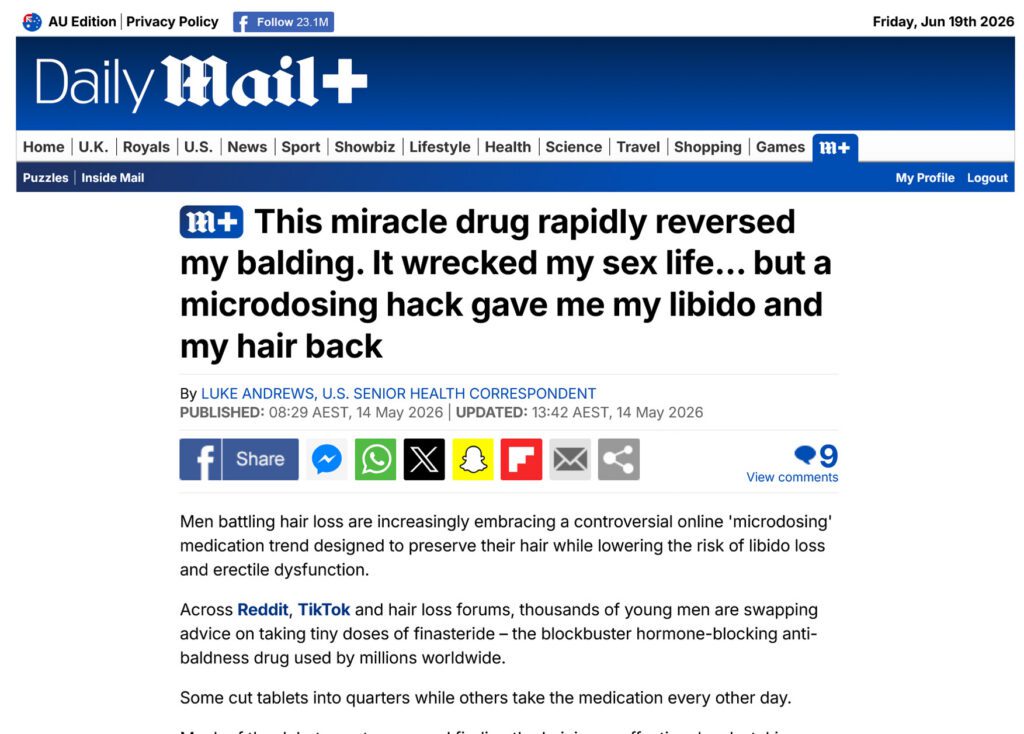
Dr. Abraham Armani was consulted by the Daily Mail as a hair restoration expert regarding the growing interest in finasteride microdosing, particularly among patients who may have experienced side effects while taking the standard 1 mg daily dose. In the article, he discusses the rationale behind lower-dose treatment strategies, their potential benefits, limitations, and the importance of individualized patient care. A PDF version of the article can be viewed or downloaded below:


With nearly two decades of exclusive experience and a global reputation in hair transplantation, Dr. Armani approaches every procedure with meticulous planning and individualized design.
To begin your personalized hair restoration journey, call our office or submit the Request a Consultation form to schedule your private, thorough one-on-one consultation with Dr. Armani.
There are many options for hair restoration. But few compare to the expert artistry that Dr. Armani’s practice offers. His approach is for the discerning patient. Get in touch to learn more.
request A consultation
Or
request a consultation
Enjoy renewed confidence with life-changing, perfect results you will be proud of.
With nearly two decades of exclusive experience and a global reputation in hair transplantation, Dr. Armani approaches every procedure with meticulous planning and individualized design.
To begin your personalized hair restoration journey, call our office or submit the Request a Consultation form to schedule your private, thorough one-on-one consultation with Dr. Armani.
There are many options for hair restoration. But few compare to the expert artistry that Dr. Armani’s practice offers. His approach is for the discerning patient. Get in touch to learn more.
request A consultation
Or
request a consultation
