Hair Transplant Candidacy

 
Determining whether someone is a true candidate for hair transplantation is the single most important factor when considering surgery—and one of the primary reasons patients must choose the right clinic. Unfortunately, many facilities that are not specialized in hair restoration either do not know how to accurately determine candidacy or they may choose not to make an honest recommendation because they prioritize the clinic’s economics over the patient’s long-term well-being.
 
The answer to whether a patient is a good candidate is not simple, and it is certainly not a matter of rigid rules such as age, gender, or a quick glance at the scalp. Instead, it requires a thorough, individualized assessment that considers dozens of medical and long-term variables.
Why Candidacy Is So Complex

1. Identifying the True Cause of Hair Loss

Before transplantation can even be considered, the underlying cause of hair loss must be determined. Some forms of alopecia are temporary, reversible, or medically driven—and performing a hair transplant in those situations would be inappropriate and potentially harmful.
 

2. Differences Between Male and Female Candidates

Candidacy differs significantly between men and women:
 
Men often experience patterned loss that is suitable for transplantation.
 
Women, however, frequently experience diffuse thinning, which sometimes includes the donor region. In these cases, hair transplantation may not be advisable or effective.
 

3. Age as a Critical Factor

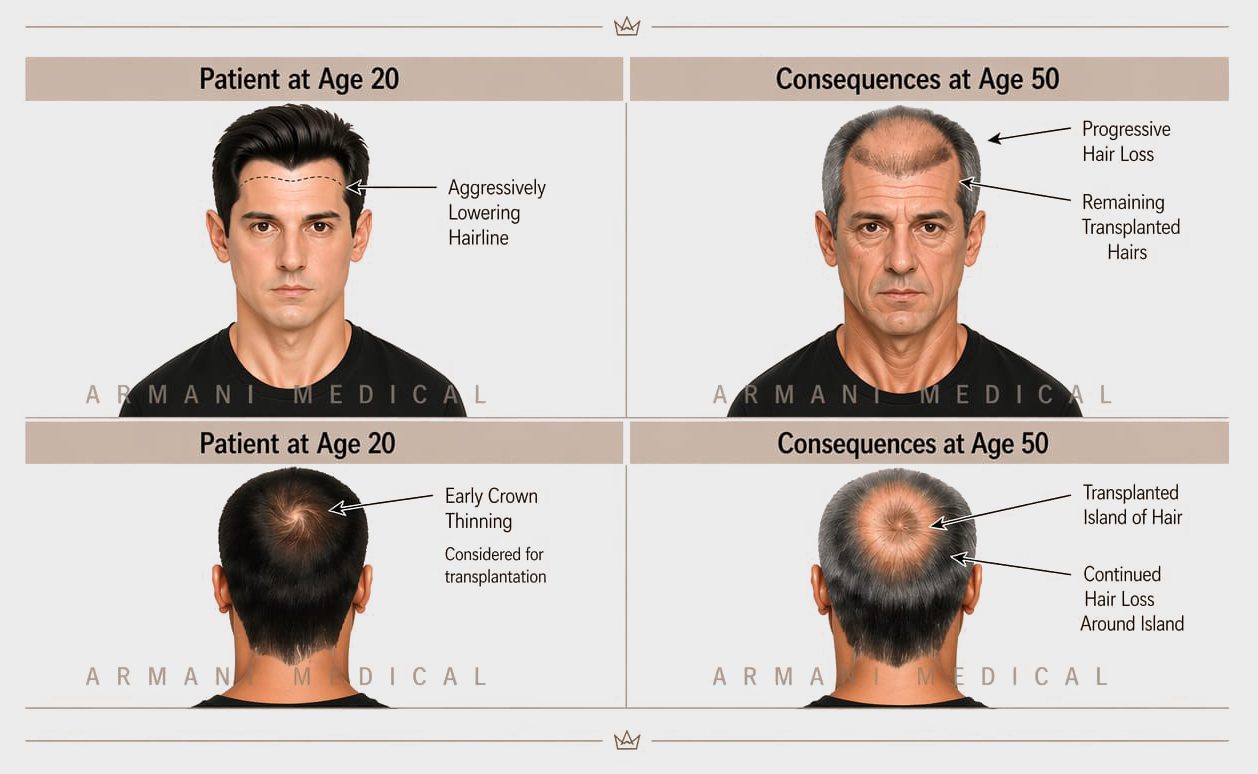
Age plays a central role in determining whether someone is a suitable candidate. Very young patients—particularly those in their late teens or early twenties—often have unstable and rapidly evolving hair loss, making long-term planning extremely difficult. Operating too early may exhaust donor resources prematurely or create unnatural patterns as their native hair continues to recede.
 
Older patients, by contrast, often have a more predictable pattern of loss, allowing for safer, more strategic long-term planning.
 

4. Current Pattern and Degree of Hair Loss

A patient’s present level of thinning is only part of the equation. The surgeon must also anticipate future hair loss, including the likelihood of progression over the next 5, 10, or 20 years.
 

5. Stability of Future Hair Loss

Patients with rapid, active thinning—especially young patients—are often poor candidates, particularly if they are not taking Finasteride or other stabilizing medications.
 

6. Use (or Intolerance) of Medical Therapy

Finasteride, minoxidil, and other medications play a major role in stabilizing hair loss and protecting long-term results.
 
A patient’s tolerance, side-effect history, and willingness to continue medical therapy must all be considered.
 

7. Donor Supply Today and Over a Lifetime

A responsible evaluation must consider:
 
  • Current donor density

  • Long-term donor reserves

  • Hair characteristics

  • Safe extraction limits

The long-term balance between donor demand and donor availability
 
A responsible surgeon must ensure that donor resources are not depleted early, leaving the patient with limited options in the future.

The Armani Medical Approach: Patient-First, Not Clinic-First

At Armani Medical, we take pride in evaluating candidacy based solely on what is truly best for the patient, not what is profitable for the clinic. If a patient is not a good candidate—now or ever—we communicate that clearly. If a patient may be a better candidate several years from now, we explain why and outline a thoughtful long-term strategy.
 
This meticulous approach to candidacy protects patients from unnecessary procedures, poor outcomes, and donor depletion—issues that often arise when clinics prioritize volume rather than individualized medical judgment.

Understanding When Hair Transplantation May Not Be the Right Choice

Even when a patient is motivated, emotionally ready, and financially prepared, a hair transplant may not always be the appropriate or responsible decision. Hair transplantation permanently redistributes a limited donor supply, and outcomes depend not only on surgical technique, but also on proper patient selection, timing, and long-term planning.
 
At Armani Medical, candidacy for hair transplantation is determined through careful medical evaluation and education, with the goal of helping patients make informed, responsible decisions about their care.

Situations Where a Hair Transplant May Be Best Avoided or Postponed

Based on widely accepted medical principles and clinical experience, hair transplantation is often not recommended immediately in certain situations, including:

  • Younger patients with ongoing or rapidly progressive hair loss, where the final pattern of hair loss has
    not yet become clear
  • Patients whose hair loss has not stabilized, increasing the likelihood of continued thinning after surgery
  • Patients who are not using or cannot tolerate medical therapy, such as finasteride, when medical
    management may be an important first step
  • Patients with diffuse or widespread thinning, where donor hair availability and long-term planning
    require particular caution


In these situations, proceeding too early may increase the risk of suboptimal or short-lived results. For some patients, medical therapy, observation, or simply waiting for hair loss to stabilize may be the most
appropriate initial approach.

A Conservative, Patient-Centered Approach

Throughout his career, Dr. Abraham Armani has emphasized patient education, transparency, and thoughtful decision-making in hair restoration. At Armani Medical, consultations are designed to help patients understand not only when hair transplantation can be effective, but also when it may be premature or inadvisable.

As part of this conservative approach, a meaningful percentage of patients who seek consultation are advised to delay or avoid hair transplantation, at least temporarily, based on factors such as age, hair loss progression, donor characteristics, or the potential benefit of medical treatment. In many cases, starting or optimizing non-surgical therapy and reassessing over time represents the most responsible first step.

Media Coverage Emphasizing Caution and Patient Awareness

Dr. Armani’s patient-focused philosophy has been reflected in national and international media coverage, including an interview with El Diario.

In the article “Tenga cuidado con el trasplante de cabello” (“Be Careful with Hair Transplantation”), Dr. Armani discusses the importance of patient awareness and education, understanding the limitations of hair transplantation, recognizing that not all patients are appropriate candidates, and approaching hair restoration with caution rather than urgency.

This feature represents one of many efforts by Dr. Armani to encourage responsible decision-making in hair restoration, emphasizing what is medically appropriate for the patient rather than focusing solely on procedural volume or financial considerations.

A responsible consultation sometimes means being told to wait — or not to proceed at all.

Final Thoughts on Candidacy

Determining candidacy for hair transplantation is a highly nuanced medical decision, not a sales-driven determination. It requires a thorough evaluation of:
 
  • The cause of hair loss

  • Present and future patterns

  • Donor strength and lifetime reserves

  • Age and hair-loss trajectory

  • Medication history and stability

  • Gender-specific considerations

  • Long-term planning and aesthetic vision

A poor candidacy decision early in life can permanently exhaust donor supply, produce unnatural results, or cause lifelong cosmetic limitations.
 
At Armani Medical, every evaluation begins with one guiding principle:
 
Determine honestly and accurately whether transplantation is truly in the patient’s best long-term interest.


AWARDS

MEMBERSHIPS

Enjoy Your Own Hair Again

Enjoy renewed confidence with life-changing, perfect results you will be proud of.

With nearly two decades of exclusive experience and a global reputation in hair transplantation, Dr. Armani approaches every procedure with meticulous planning and individualized design.

To begin your personalized hair restoration journey, call our office or submit the Request a Consultation form to schedule your private, thorough one-on-one consultation with Dr. Armani.

There are many options for hair restoration. But few compare to the expert artistry that Dr. Armani’s practice offers. His approach is for the discerning patient. Get in touch to learn more. 

request A consultation

Start Your Hair Transformation Today

Loved By Patients
Dr. Armani Review Stars