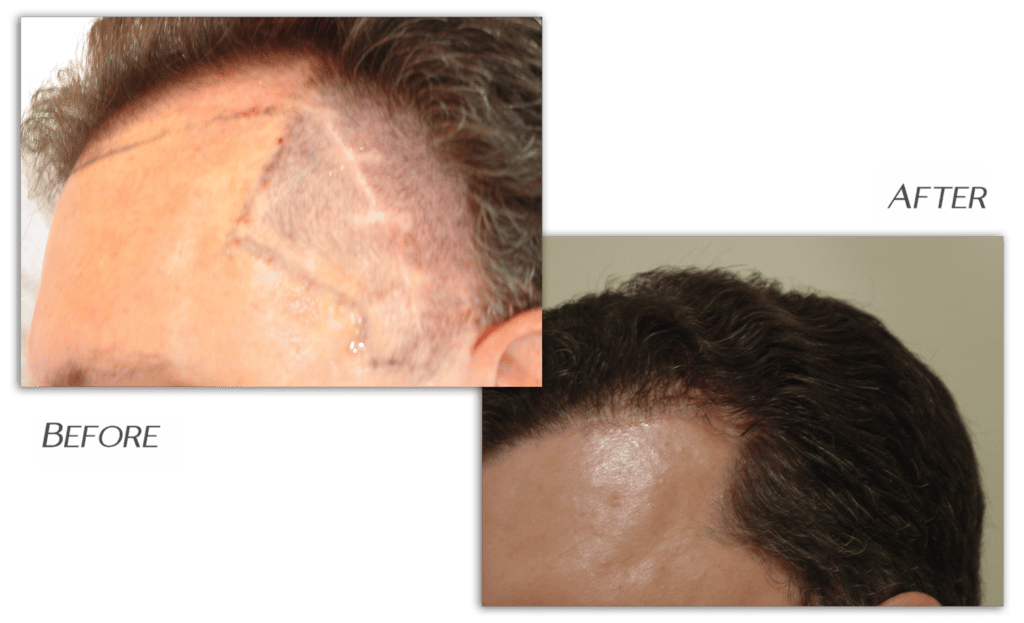
Hair transplant repairs and revisions refer to procedures performed to correct or improve the results of previous hair restoration surgeries. These procedures may involve addressing significant problems, such as unnatural hairlines, poor growth, or visible scarring, or refining and enhancing an existing result by improving density, hairline design, and overall naturalness. In select cases, treatment may also include improvement of a donor scar or correction of small overharvested areas within the donor region. Less commonly, they may involve correction of outdated plug grafts from earlier techniques.
At Armani Medical, these procedures are approached with careful analysis and long-term planning. The focus is on restoring natural growth patterns, redesigning hairlines with precision, and preserving the remaining donor supply. Depending on the specific issues, correction may involve hairline redesign using the ARTS™ approach, removal and/or redistribution of prior grafts, correction of hair angle and direction, scar revision, and the strategic placement of new grafts to improve density and provide camouflage when appropriate. Each case is highly individualized, with the goal of achieving meaningful, natural improvement while respecting the limitations created by prior procedures. In more significant repair cases, the priority is not necessarily to maximize density, but rather to recreate a natural appearance—even if the resulting density is not ideal.
Dr. Armani often emphasizes to his patients that it is more acceptable to have naturally thinning hair or even a bald scalp than to have an unnatural or poorly executed hair transplant result. Some patients with previous suboptimal results report that it is especially frustrating because they feel that others are “staring” at their hair. While this perception may sometimes be exaggerated, it is not uncommon for unnatural hairlines to draw attention—not necessarily out of judgment, but because they may appear inconsistent with natural hair growth patterns. For this reason, repair procedures are approached with a strong emphasis on natural appearance, surgical judgment, and long-term planning.