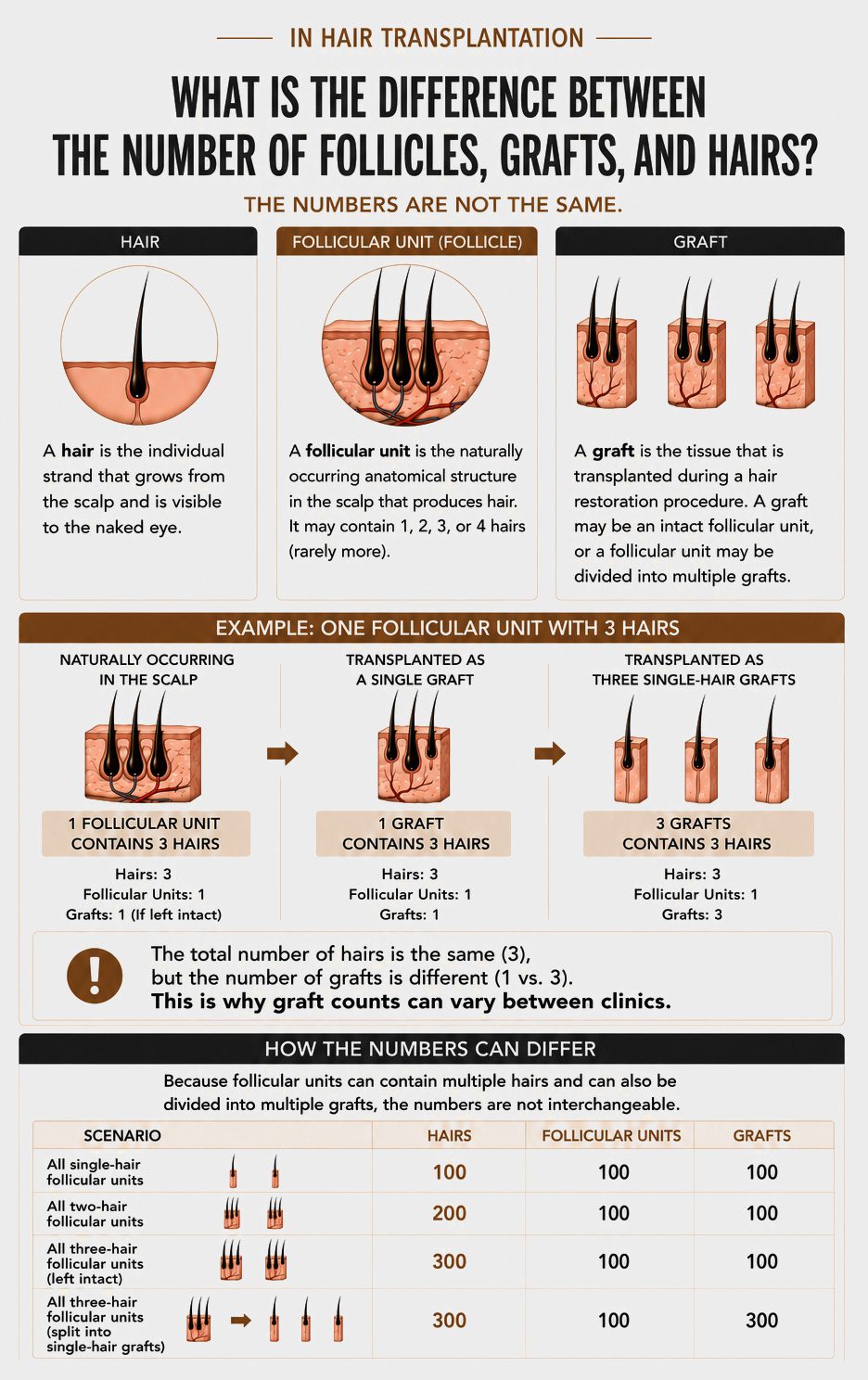
One of the most common sources of confusion for prospective hair transplant patients is the terminology used to describe the amount of hair being transplanted. Before discussing hair transplantation, it is important to clearly define the terms hair, follicular unit, and graft, because these terms are often used interchangeably even though they are not synonymous.
Misunderstanding these definitions can lead to considerable confusion when comparing procedures, evaluating treatment recommendations, or reviewing information from different clinics. In some cases, differences in how these terms are used can even create a misleading impression regarding the size or scope of a procedure.
Hair
A hair is the individual strand that emerges from the scalp and can be seen with the naked eye.
Follicular Unit
A follicular unit, often referred to simply as a follicle, is the naturally occurring anatomical structure within the scalp that produces hair. A single follicular unit may contain one, two, three, or occasionally four hairs growing together as a natural group.
Graft
A graft is the tissue that is transplanted during a hair restoration procedure. In many cases, a graft consists of an intact follicular unit. However, a follicular unit may sometimes be divided into multiple grafts, particularly during hairline reconstruction where individual single-hair grafts are often needed to create the most natural appearance.
Why Can These Terms Be Confusing?
Many patients assume that a hair, follicular unit, and graft all mean the same thing. They do not.
For example, a naturally occurring follicular unit may contain three hairs. That follicular unit may be transplanted as a single three-hair graft, or it may be carefully divided into smaller grafts to create multiple single-hair grafts for hairline refinement.
As a result:
- One follicular unit may contain multiple hairs.
- One follicular unit may become one graft.
- One follicular unit may become multiple grafts.
- The number of hairs, follicular units, and grafts are therefore not always the same.
This distinction is extremely important because it demonstrates why comparing graft counts between clinics can sometimes be misleading.
For example, one naturally occurring follicular unit may contain three hairs. One clinic may transplant it as a single three-hair graft, while another clinic may divide that same follicular unit into three separate single-hair grafts.
The total number of hairs transplanted is identical, yet the reported graft count is dramatically different.
This is why patients should be cautious when comparing numbers between different clinics. Some clinics emphasize the total number of hairs, while others emphasize the number of grafts or follicles. In some cases, this may simply reflect different terminology. In other cases, however, the larger number may be presented in a way that makes the procedure sound more extensive than it truly is.
Unfortunately, one of the most misleading practices in some areas of the hair transplant industry is creating confusion around the number of follicles, grafts, or hairs being transplanted. Patients may believe they are receiving a larger procedure when the actual number of transplanted follicular units may be substantially less impressive than the number being promoted.
At Armani Medical, we generally discuss procedures in terms of follicular units and grafts because these are the actual anatomical units being harvested, dissected, and transplanted. We believe this provides patients with a more meaningful and transparent way to understand their procedure.
Why Are Single-Hair Grafts Important in the Hairline?
It is also important to understand that not all grafts are used in the same way. During hairline restoration, creating a natural appearance is often more important than simply maximizing density.
A natural hairline is typically soft, irregular, and composed primarily of individual hairs rather than dense clusters of multiple hairs emerging from the same point.
For this reason, even follicular units that naturally contain multiple hairs are frequently dissected into finer single-hair grafts and strategically placed along the leading edge of the hairline. As the surgeon moves farther behind the hairline, stronger grafts containing two, three, or more hairs are used to gradually increase density and create a natural transition.
This artistic distribution of single-hair and multi-hair grafts is one of the fundamental principles of modern hair transplantation and helps create results that appear natural both up close and at a distance.
Why Doesn’t Armani Medical Price Procedures Based on an Exact Number of Grafts or Hairs?
For many of the reasons discussed above, at Armani Medical we do not generally price procedures based solely on an exact number of hairs, follicles, follicular units, or grafts. We believe this is a more honest and realistic approach to hair restoration.
In reality, it is often impossible to determine with complete accuracy in advance exactly how many hairs or follicular units will ultimately be harvested and transplanted.
For example, during an FUT procedure, an irregularly shaped donor strip is carefully removed from the donor area. Prior to microscopic dissection, there is no practical way to know exactly how many follicular units or hairs are contained within that specific piece of tissue. The final graft count is only known after the tissue has been completely dissected and prepared under magnification.
Similarly, during an FUE procedure, follicular units are harvested individually. However, some naturally occurring multi-hair follicular units may later be divided into finer single-hair grafts for hairline refinement and naturalness. As a result, the final number of grafts transplanted may differ from the number of follicular units originally harvested.
In addition, once grafts are harvested, whether through FUE or FUT, they must be carefully counted and prepared by the surgical team. The number of harvested follicular units, the number of prepared grafts, and the number of recipient sites created and filled are all counted during different stages of the procedure. Each technician may also be responsible for counting the grafts or sites within their own assigned area, and those numbers are later added together. In real surgical practice, these counts often do not match perfectly to the exact number, which is another reason why pricing a procedure around an exact graft count can create a misleading sense of precision.
For these reasons, patients are often better served by focusing on the overall treatment goal rather than a specific graft number.
Instead, Dr. Armani evaluates the extent and pattern of hair loss, the quality and availability of the donor supply, the desired density, the characteristics of the patient’s hair, and the long-term treatment plan. Based on these factors, he determines the approximate number of grafts required to achieve appropriate coverage and a natural-looking result.
Ultimately, patients are not purchasing a specific number of hairs or grafts. They are investing in a carefully designed surgical plan intended to create the best possible cosmetic outcome while preserving donor resources for the future.
The illustration below provides a simplified visual example of how hairs, follicular units, and grafts relate to one another, and why comparing graft counts between clinics may not always be an apples-to-apples comparison.