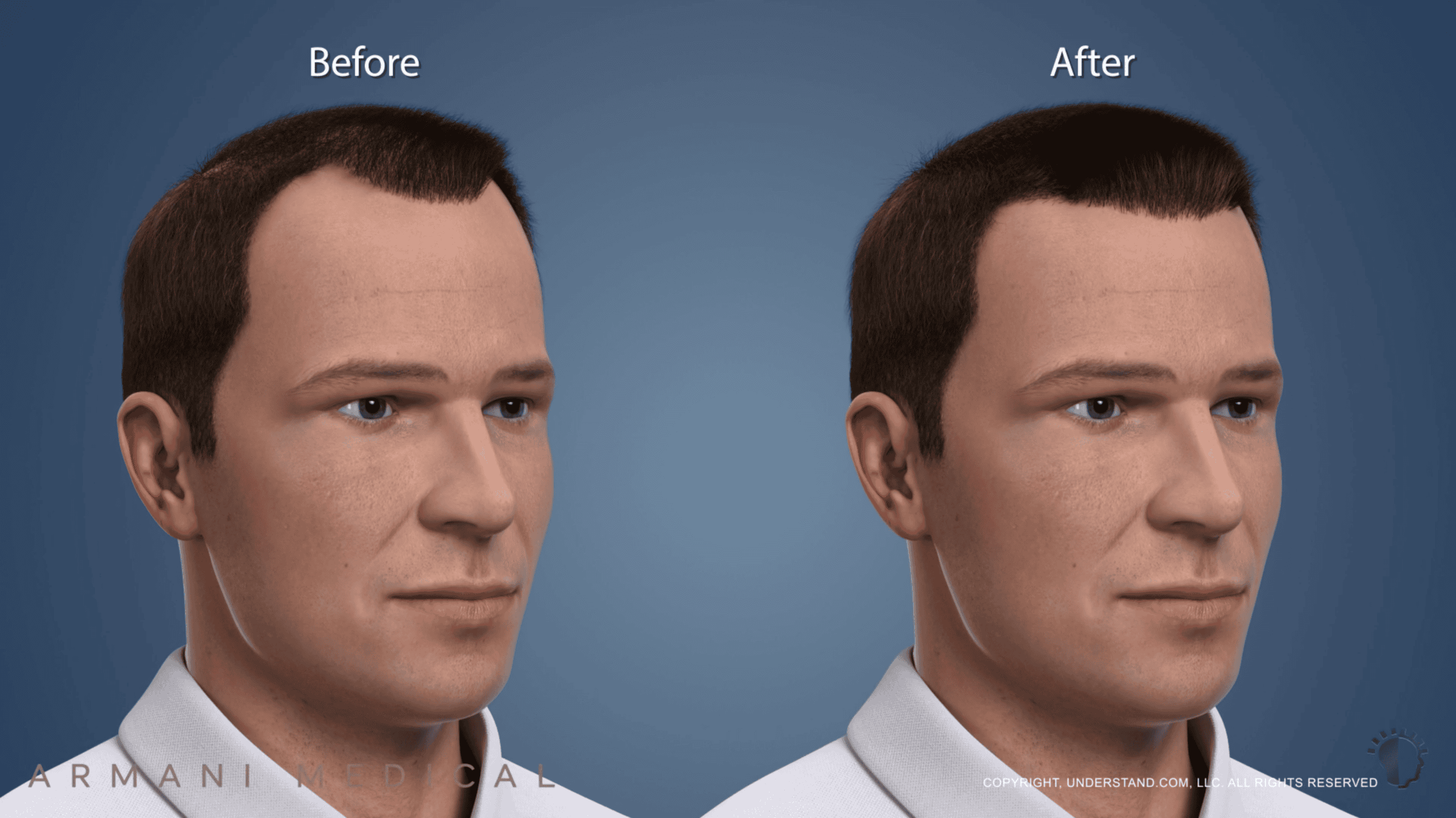
Section 1 (Timestamp 0:00) — Brief Summary of Hair Loss and Transplantation
Hair transplantation is a minimally invasive procedure that moves hair follicles from a donor site to areas of the scalp where there is hair loss or thinning. While many factors can contribute to hair loss, the most common cause is androgenetic alopecia, also known as male or female pattern hair loss. This type of hair loss typically affects specific areas of the scalp, including the hairline, the top, and the crown. Androgenetic alopecia is influenced by a hormone called dihydrotestosterone, or DHT, which can cause susceptible hair follicles to gradually miniaturize over time. Hair follicles along the back and sides of the scalp are generally more resistant to the effects of DHT and are therefore less susceptible to thinning, allowing them to be used as a donor source for transplantation into areas of thinning or hair loss. For appropriately selected individuals, hair transplantation can be an effective and long-lasting solution.
Section 2 (Timestamp 1:00) — Hair Transplantation Candidacy and Evaluation
Not everyone is an ideal candidate for hair transplantation. Factors such as age, the degree and pattern of hair loss, the rate of hair loss progression, and donor hair availability all play an important role. In some cases, prescription medication such as finasteride and minoxidil may be more appropriate, either alone or in combination with a surgical procedure. Performing an aggressively designed hair transplant at a young age, particularly in the setting of ongoing rapid hair loss, can lead to unnatural results over time as native hair continues to thin, transplanted hair may remain in place, potentially creating isolated areas or islands of transplanted hair that no longer match the surrounding scalp. In addition, the donor supply is limited and may not be sufficient to keep pace with future hair loss, particularly in younger patients. It is therefore critical for an experienced hair transplant surgeon to design the hairline, which will likely remain permanent, with careful consideration of potential future hair loss. A thorough evaluation by an experienced hair transplant surgeon is necessary to determine the most appropriate treatment plan for each patient.
Section 3 (Timestamp 2:14) — A.R.T.S.™ Hairline Design
Designing a hairline should be more than simply restoring lost hair. Dr. Armani’s trademarked ARTS, which stands for Artistically Redesigned Transplant Surgery, is a meticulous and artistic approach to hair restoration. Rather than recreating the patient’s original hairline, Dr. Armani redesigns it while considering the patient’s facial structure, age, ethnic characteristics, existing pattern of hair loss, and other individualized factors. The result may be a newly designed hairline that is even more aesthetically appropriate for the patient than the original hairline that was lost. Considerations in the ARTS hairline redesign include existing hair loss pattern and anticipated future hair loss, patient’s age and long-term hairline planning, facial and forehead shape, proportions, and underlying bone structure, racial and ethnic characteristics, and natural asymmetry and irregularities of the hairline.
Section 4 (Timestamp 3:16) — Hair Transplant Procedure Explained
During the procedure, patients are typically seated or lying down comfortably while listening to music or watching media. Hair transplantation is performed under local anesthesia, which is administered to help patients relax, allowing them to remain comfortable but responsive throughout the process. Depending on the specifics of the case, the procedure usually takes about four to six hours, and short breaks may be taken for comfort as needed.
Section 5 (Timestamp 3:43) — FUT and FUE Hair Transplants Explained and Compared
There are two main methods utilized when performing hair transplantation: follicular unit transplantation, or FUT, also known as linear strip excision or LSE or strip surgery, and follicular unit extraction, or FUE, also known as follicular unit excision. While both methods involve relocating hair follicles from the donor area to areas of thinning or baldness, they differ in how the follicles are harvested. During FUT, a surgeon removes a thin strip of tissue at a shallow depth within the skin. Next, the donor area is closed using a precise suturing technique, and the strip is dissected into individual follicular units by specialized hair transplant technicians. During FUE, individual follicular units are extracted directly using specialized punches, which are typically less than one millimeter in diameter, leaving small sites that heal without sutures. Regardless of the method used, the goal is to obtain healthy follicular units that can be transplanted into areas of hair loss. FUE avoids a linear scar and may allow patients to wear their hair shorter, whereas FUT may require slightly longer hair in the donor area for optimal coverage.
Section 6 (Timestamp 5:05) — Dr. Armani’s P.U.R.E.™ FUE Extraction
When manually harvesting hair follicles during an FUE procedure, maintaining a uniform, consistent punch depth throughout the procedure can be extremely difficult. Dr. Armani’s trademarked PURE follicular extraction system, which stands for Precise Ultra Refined Extraction, is a specialized harvesting method created to consistently limit FUE punch penetration to the absolute minimum depth necessary for safe extraction. After determining the length of a patient’s hair follicles, a customized depth control sleeve is precisely handcrafted and fitted to the FUE punch. This sleeve mechanically limits the FUE punch to a uniform depth rather than relying on manual control of punch depth with each extraction. By limiting unnecessary penetration, PURE is designed to minimize tissue trauma and bleeding while helping maximize graft health and survivability.
Section 7 (Timestamp 6:03) — Hair Site Creation and Graft Placement
Once the follicular units have been removed and prepared, the next steps are recipient site creation followed by graft placement. This is one of the most critical parts of the procedure. Using specialized microblades or similar instruments, your surgeon will create the recipient sites with careful attention to design, angle, direction, and depth in order to replicate natural hair growth patterns. Once the recipient sites have been created by the surgeon, the surgical team places the grafts into these sites one at a time. These sites are distributed in a carefully designed, varied, and individualized pattern that mimics the natural variation seen in native hair growth. The goal is to create a result that appears natural, both in the short term and over time.
Section 8 (Timestamp 6:51) — Complications and Recovery
It is uncommon to experience serious complications from hair transplantation. Rare potential risks may include infection, postoperative bleeding, or unfavorable scarring. When performed by an experienced hair transplant team using proper technique and with adherence to recommended postoperative instructions, these potential occurrences are very uncommon.
Hair transplantation is an outpatient procedure, and you will be able to return home the same day. Following the procedure, some redness, swelling, and scabbing are expected to develop in the transplanted areas, all of which typically resolve within the first ten days. You may experience some swelling around the forehead or eyes in the first week following the transplantation, which typically subsides within a few days. Appropriate use of a loose-fitting hat that does not contact the transplanted follicles can help camouflage these temporary cosmetic changes and may also provide some protection to the grafts from incidental contact.
Non-contact rinsing can begin as early as the first day after the procedure, but do not touch the transplanted follicles. Patients can generally resume normal shampooing around ten days, which also helps facilitate the natural removal of scabs. A topical antibiotic ointment is typically applied to the donor area for approximately ten to twelve days. With some basic precautions, most patients are able to resume normal daily activities as early as the following day. Haircuts may be resumed after approximately ten to fourteen days. Typically, exercise can be resumed between ten days and four weeks, depending on the specifics of the case and the type of procedure performed.
In the first few weeks, a temporary shedding phase known as shock loss often occurs, during which the transplanted hair shafts fall out while the follicles themselves remain intact beneath the skin. Over time, the follicles enter a resting phase before gradually producing new hair. Final results are generally achieved within approximately twelve to twenty-four months.